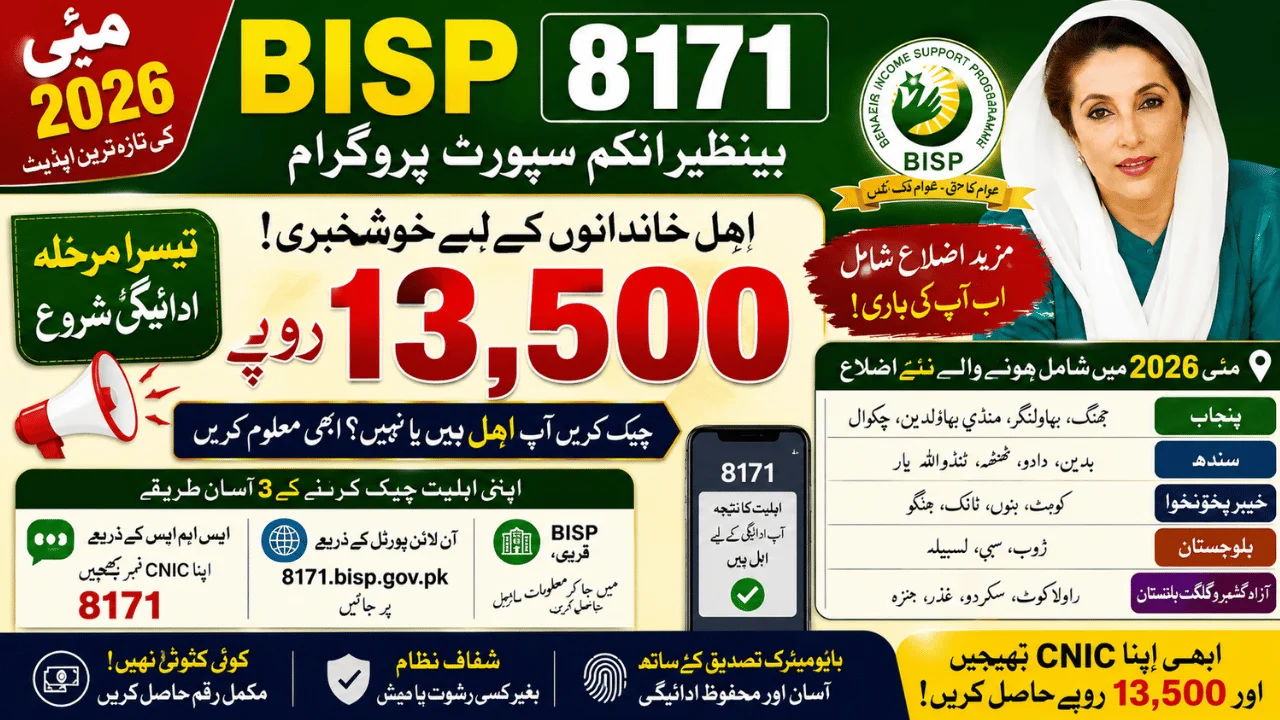
For many low-income families in Pakistan, the BISP 8171 payment is not just financial support—it’s a lifeline. With rising inflation and basic household costs increasing every month, even a small delay or confusion about eligibility can create serious stress.
As of May 2026, the government has introduced important updates in the Benazir Income Support Programme (BISP). These updates include expanded coverage, improved verification systems, and smoother payment methods. If you’re unsure whether you qualify for the Rs. 13,500 installment or how to receive it without issues, this detailed guide will walk you through everything in a clear, practical way.
What’s New in BISP 8171 May 2026 Payment?
The May 2026 update focuses on inclusion, transparency, and faster payments. Unlike previous phases, this time the program is targeting families that were either left out or marked “under review” earlier.
Key Highlights of May 2026 Update
- More districts and rural areas are now fully active
- Payments remain Rs. 13,500 per eligible household
- Improved CNIC verification through NADRA integration
- Faster SMS confirmation via 8171 system
- Special focus on widows, disabled persons, and extreme poverty households
This expansion is particularly important for families who were previously marked as “ineligible” due to incomplete data or outdated survey records.
Who Is Eligible for Rs. 13,500 in May 2026?
Eligibility is not random—it is based on a structured poverty assessment system called the NSER (National Socio-Economic Registry).
Basic Eligibility Criteria
You are likely eligible if:
- Your CNIC is registered in the NSER database
- Your poverty score (PMT score) is 32 or below
- You do not have a government job
- You do not own large property, business, or vehicle
- Your household income falls under the low-income bracket
Special Relaxation Categories
Some groups get slight relaxation in eligibility:
- Widows
- Disabled individuals
- Female-headed households
For these groups, the PMT score allowance may go up to 35, depending on verification.
Newly Included Areas – What It Means for You
In May 2026, BISP has quietly activated several previously overlooked districts and rural pockets.
Why This Matters
- Families marked “District Inactive” earlier can now receive payments
- Villages with limited access to BISP centers are now covered
- Mobile camps and payment vans are being introduced in remote areas
Real-life example:
A family in a rural tehsil that previously had to travel 40–50 km for verification can now access services within their own district. This reduces travel cost and dependency on agents.
How to Check BISP 8171 Eligibility (Step-by-Step)
Many people lose their payments simply because they don’t check their status correctly. Here are the most reliable methods:

1. SMS Method (Fastest Option)
- Open your mobile message app
- Type your 13-digit CNIC number
- Send it to 8171
You will receive one of these responses:
- Eligible
- Not Eligible
- Under Verification
2. Online Portal Method
- Visit the official 8171 web portal
- Enter your CNIC number
- Fill in the captcha code
- Click on “Check Status”
This method provides more detailed information, including payment status.
3. BISP Tehsil Office Visit
Visit your nearest BISP office if:
- You didn’t receive SMS
- Your status shows “under review”
- You want to update your record
Always carry:
- Original CNIC
- Registered mobile number
Understanding 8171 Messages – What They Actually Mean
| Message Status | What It Means | What You Should Do |
|---|---|---|
| Eligible | You qualify for payment | Collect your Rs. 13,500 |
| Under Review | Data is being verified | Wait or visit BISP office |
| Not Eligible | Criteria not met | Apply for resurvey |
| Payment Ready | Money is transferred | Go for biometric verification |
How to Receive Your Rs. 13,500 Payment Safely
Receiving your payment correctly is just as important as being eligible.
Payment Collection Methods
- Biometric verification through authorized retailers
- BISP payment centers
- Mobile payment vans (in remote areas)
Important Tips
- Never pay any agent or middleman
- Always verify amount before leaving the center
- Use your own thumb for biometric verification
- Keep your CNIC updated with NADRA
Practical advice:
If biometric verification fails, don’t panic. Visit NADRA to update fingerprints and retry within a few days.
Common Problems and How to Solve Them
CNIC Not Found
- Your data may not be updated in NSER
- Solution: Apply for a new survey
Biometric Failure
- Often happens with elderly individuals
- Solution: Update fingerprints at NADRA
Payment Deduction Issues
- Report immediately at BISP complaint center
- Never accept partial payment
Why BISP 8171 Is More Important in 2026
With economic challenges increasing, government support programs are becoming more critical than ever.
Impact on Families
- Helps manage basic food expenses
- Supports children’s education
- Reduces dependency on loans
- Provides financial dignity to women
Unlike past years, the 2026 system is more data-driven, reducing corruption and ensuring that funds reach the deserving families.
FAQs – Real Questions People Are Asking
How often is BISP payment given?
Payments are usually released every quarter, but exact timing may vary based on government schedule.
Can I apply if I was previously rejected?
Yes, you can request a resurvey to update your poverty score.

Is there any fee for registration or payment?
No. BISP is completely free. Any demand for money is fraud.
What if I change my mobile number?
Update your number at the BISP office to continue receiving SMS alerts.
Can men apply for BISP?
The program mainly prioritizes women, but households are considered as a whole.
Final Thoughts – What You Should Do Right Now
If you haven’t checked your eligibility yet, do it today. The BISP 8171 May 2026 payment expansion means thousands of new families are now qualifying who were previously left out.
Action steps:
- Send your CNIC to 8171
- Confirm your eligibility
- Visit the nearest center if needed
- Keep your documents updated
This program is designed to support you—but only if your data is correct and verified. Staying informed is the key to receiving your full benefit without delays or deductions.